Frequently Asked Questions
This guide answers essential questions about regulated, private water companies—covering how they operate, how water rates and quality standards are set, and what measures are taken to ensure safe, affordable, and secure tap water across the communities they serve.
FAQs
What is a regulated, private water company?
Regulated, private water companies own and operate drinking water and wastewater systems and are subject to rate and environmental regulations. They provide safe, reliable and affordable water and wastewater service, safeguarding public health and promoting environmental stewardship. Approximately 40 million Americans are served by regulated, private water companies.
What are the key benefits of having a regulated, private water company?
Regulated, private water companies offer numerous benefits, including:
- Safe and reliable water and wastewater services
- Strategic and ongoing investment in water systems (over $6 billion annually by the 15 largest companies)
- Unparalleled expertise in water management
- Improving local economies through investment and job creation
- Strong environmental stewardship and water security
- High standards for workplace safety
- Additional regulatory oversight for accountability
How can I find out who my water provider is?
Visit saferwater.org to find out if you are served by a regulated, private water company.
How are my water rates set?
Rates for regulated, private water companies are set by independent state utility commissions through transparent regulatory processes that ensure customers receive safe and reliable services at just and reasonable rates. For customers of government-run systems, rates are typically set by local elected officials without this same level of independent regulatory oversight that ensures that the utility is spending money reasonably, meeting health and safety requirements and has long-term plans for replacing aging pipelines.
Who regulates drinking water quality?
Regulations for drinking water primarily fall under the U.S. Environmental Protection Agency and the federal Safe Drinking Water Act. Individual states also help monitor and enforce compliance with these standards through entities like state departments of health.
About My Tap Water
Is my tap water safe to drink if supplied by a regulated, private water company?
Yes, regulated, private water companies have a strong, industry-leading record of delivering high-quality water that meets or exceeds federal standards. Multiple studies of EPA data show regulated, private water companies are less likely to violate water quality standards than government-run systems.
How can I ensure my drinking water is safe?
NAWC member companies are dedicated to safeguarding public health and delivering safe, reliable and affordable water. They ensure this through proactive investments in water infrastructure, replacing outdated systems, deploying advanced leak-detection technology and robust emergency preparedness and cybersecurity measures to protect water and wastewater assets. NAWC member companies are committed to providing transparent water quality information to their customers. Information about water quality is detailed in a company’s annual Consumer Confidence Report (CCR) usually available on their website.
What is in my tap water?
Tap water contains more than just H₂O. It can include essential minerals, fluoride (often added for dental health), and disinfectants like chlorine or chloramine, which kill germs. Regulated, private water companies conduct daily testing for more than 90 contaminants including things like PFAS treating the water to ensure that other bad substances are like chemicals, pesticides and more are filtered out of your water before it reaches your tap.
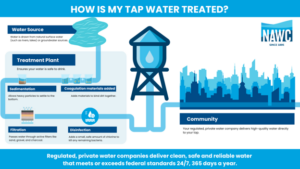
How is my tap water treated?
Water treatment is a highly sophisticated, multi-step engineering process designed to remove impurities. While treatment varies based on the water source (surface water vs. groundwater), it generally follows these key steps: Coagulation and Flocculation (adding gentle additives to bind dirt together), Sedimentation (allowing heavy particles to settle to the bottom), Filtration (passing water through active filters like sand, gravel, and charcoal), and Disinfection (adding a small, safe amount of chlorine to kill any remaining bacteria).
Should I be concerned about lead in my drinking water?
Lead exposure can be a health concern, especially as lead was used for service line connections to homes prior to World War II. NAWC member companies actively address this by investing heavily to replace lead-lined pipes and leading efforts to remove lead from water systems.
Should I be concerned about PFAS in my drinking water?
Per- and Polyfluoroalkyl Substances (PFAS), also known as “forever chemicals,” are long-lasting chemicals that are widely used in everyday items. While NAWC members do not create, produce or use these chemicals, they invest millions to remove them and actively fight for regulations to protect communities.
Affordability
How do private water companies work to ensure water affordability?
NAWC member companies are committed to keeping water affordable and to delivering safe water and reliable service to their customers. They advocate for sustained federal funding for programs like the Low Income Household Water Assistance Program (LIHWAP) and many also operate their own water assistance programs to help customers maintain access to essential water services.
The rates charged by NAWC member companies also are monitored closely by state regulatory commissions. These experts ensure that regulated, private water companies are charging customers the cost to provide service while making system improvements that are necessary.
Bottle Water
Is tap water more affordable than bottled water?
Yes, tap water is more affordable than bottled water. Tap water typically costs just a few cents per gallon while bottled water is 100 times that or more.
Why should I choose tap water over bottled water?
Regulated, private water companies work 24/7 to ensure American households have tap water that is clean, safe and reliable. While some data indicate distrust in tap water can lead to bottled water consumption, NAWC members consistently provide high-quality, federally compliant tap water. Further, tap water is subjected to more rigorous, frequent testing and reporting standards by the EPA than bottled water.
Infrastructure and Technology
Why is investment in water infrastructure so important?
Investment is so important because much of America’s water infrastructure, including pipes, treatment plants and storage facilities, was built between the 1930s and 1970s and is nearing or past the end of its useful life. Aging pipes can lead to water main breaks, water loss through leaks and increased risk of contamination. More than 6 billion gallons of treated water are lost each day in the U.S. due to leaky pipes. The American Society of Civil Engineers gave the nation’s drinking water infrastructure a “C-” in its most recent report card, signaling an urgent need for investment. Regulated, private water companies address this challenge head-on, investing over $6 billion annually across the 15 largest companies alone to ensure safety and reliability by repairing, replacing and modernizing critical water infrastructure before problems occur.
How do regulated, private water companies use technology to improve service?
NAWC members are at the forefront of pioneering programs and deploying state-of-the-art technologies to address critical water and wastewater challenges, enhance quality and advance sustainability. These efforts, combined with consistent, forward-looking investments, have helped meet the growing demand for safe, reliable water while addressing the infrastructure needs of communities across the country.
Cybersecurity
How are regulated, private water companies addressing cybersecurity threats?
Water is critical infrastructure and protecting it from cyberattacks is a matter of national security and public health. Regulated, private water companies lead the water sector in cybersecurity preparedness with more than 90% of NAWC member companies having formal cybersecurity plans in place. To guide the sector forward, NAWC has developed a set of Cybersecurity Pillars to guide its members on best practices, compliance and long-term strategy, and actively advocates for universal cybersecurity standards to protect all Americans, regardless of their water provider. NAWC supports robust federal funding for the Water Information Sharing and Analysis Center (WaterISAC) for real-time industry-wide threat intelligence sharing and encourages all water system operators to register for CISA’s Cyber Hygiene Services. NAWC also advocates for strong ransomware protections and timely reporting of cyber incidents to CISA, as well as the development of a cyber mutual assistance program to help utilities rapidly restore operations following an incident. NAWC member companies are committed to doing everything possible to stay ahead of emerging risks, including continuously investing in the people, technology and processes needed to detect, respond to and recover from any attempted intrusion – without compromising the safety or reliability of your water supply.